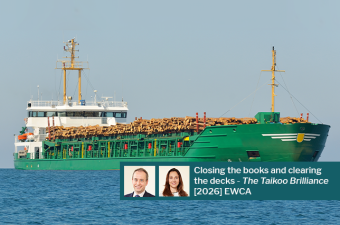
In this case, the Court of Appeal determined two issues of principle arising under the Hague/Hague-Visby Rules (“the Rules”) which had not previously been the subject of authoritative determination by the English Courts, namely:
- Whether proceedings brought solely to obtain security amount to a “suit” for the purposes of the one-year time bar in Article III,6; and
- What must be “stated” on the bill of lading for cargo to be “deck cargo” within Article I(c) (such that the Rules do not apply to it)?
The context for these issues was a dispute over whether the owners of TAIKOO BRILLIANCE were liable under four bills of lading for the misdelivery of a cargo of timber. The owners contended that the claim was time-barred under Article III,6 of the Rules. The cargo interests refuted this on the basis that: (a) proceedings to obtain security had been commenced in time; (b) some of the cargo was carried on deck such that the Rules did not apply at all to that cargo.
The Court of Appeal determined both questions in favour of the owners, who were represented by Chris Smith KC and Maya Chilaeva, instructed by HFW (Chris Metcalf, Remi Cruttenden).
Issue 1: What counts as a “suit”?
Cargo interests arrested a sister ship in Singapore to obtain security. This was done less than a year after the delivery of the cargo. The bills of lading covering the carriage of the cargo incorporated an arbitration clause however, and arbitration proceedings were only commenced more than a year after the cargo was delivered.
The owners argued that by reason of the failure of the cargo interests to commence the arbitration proceedings within a year of the discharge of the cargo, the claim was time-barred. The cargo interests argued against this that the Singaporean proceedings amounted to “suit”. In particular, they argued that such proceedings constituted “suit” according to the ordinary meaning of that word, and fulfilled the purpose of Article III,6 in that, having been required to provide security for a claim, the owners would have known that they could not close their books.
The Court of Appeal decided that proceedings commenced solely to obtain security did not amount to “suit” for the purposes of Article III, 6. In so doing, the Court relied both on previous authority to the effect that “suit” meant proceedings capable of deciding liability on the merits (for instance The Leni [1992] 2 Lloyd’s Rep 48 and Thyssen v Calypso [2000] 2 Lloyd’s Rep 243), and on the underlying purpose of Article III,6. In the latter regard, the Court thought it particularly significant that, if the cargo interests were right, obtaining security would satisfy the requirement to bring suit under Article III, 6 while leaving them free, so far as the Rules were concerned, to defer substantive proceedings indefinitely. The owners would thus be left in limbo.
Issue 2: What is a sufficient “deck cargo” statement?
Two of the four bills stated that some cargo was carried on deck and identified the number of pieces being carried on deck, but not which precise pieces were being so carried. The cargo interests argued that, in the circumstances, the cargo carried on deck was not subject to the Rules pursuant to Article I(c) thereof seeing as the relevant bills stated that that cargo was carried on deck and it was in fact carried on deck.
The owners countered this by contending that the requirement in Article I(c) that the relevant bills state on their face that the cargo was being carried on deck was not met, as that requirement could only be satisfied by the bills identifying the precise pieces of cargo carried on deck (or, at least, containing sufficient information on their face to allow that to be determined).
The Court of Appeal agreed with the owners that the statement on the face of the bills did not satisfy Article I(c) of the Rules. The Court’s conclusion was based on the wording of Article I(c), supportive authority from the Courts of British Columbia, and the underlying purpose of the requirement that the bills of lading state on their face that cargo has been carried on deck. As regards the last of these points, it was of particular importance to the Court’s conclusion that the cargo was not homogeneous, with the different pieces being of different size and hence bearing a different value. This meant that the parties to the bills could not tell from the information stated thereon the value of the cargo being carried on deck.
The Court left open the question of whether the precise parcels being carried on deck would need to be identified where the cargo is homogenous or otherwise does not differ in value between the constituent elements, although its observations suggest that such identification may nevertheless be required.
It remains to be seen whether the cargo interests will seek permission to appeal to the Supreme Court on either of the above issues.
Practical implications
The decision underlines the need to address proceedings for security and the substantive claim in parallel: cargo interests should identify the correct forum for any dispute and protect the one-year time limit notwithstanding any steps taken to obtain security. For carriers, it highlights the need to carry stowage information about each piece of cargo through into the bill; given the remaining uncertainty, the safer course is to include specific identification of on-deck items even where the cargo is entirely homogeneous.
Counsel: Chris Smith KC and Maya Chilaeva, instructed by HFW; Nigel Eaton KC and Helen Morton (for cargo interests), instructed by Preston Turnbull LLP.